Dear neighbor,
Happy New Year! As your State Senator, I look forward to continuing to serve you and our community at the Capitol, where I am working hard to address the challenges Michigan residents are facing, both in our community and across the state.
While lots of exciting work is already underway for 2026, I wanted to take a moment to reflect on the important progress made and victories won in 2025 — all while navigating unprecedented times. From protecting access to health care and securing record investments in public education, to advancing commonsense legislation to make life more affordable, my colleagues and I fought for you every step of the way. And we will continue to do so in the new year.
If you ever have any questions about the work we’re doing, want to share concerns, or need assistance in navigating a state department, please don’t hesitate to reach out to my office by emailing SenSMcCann@senate.michigan.gov or calling 517-373-5100. We’re here to help.
Take care,
Sean McCann
State Senator
District 19
Major State Budget Wins
I fought hard to help deliver a bipartisan state budget that reflects the priorities you care about — strong schools, safe communities, improved infrastructure, access to health care, a clean environment, and opportunity for all.
Michigan’s final 2026 budget deal works to fill critical gaps caused by cuts from the Trump administration, ensures stability in the services people rely on to survive, and protects what matters most to Michigan families. More specifically, it includes investments to:
- Support Students and Schools: Secures the highest-ever per-pupil funding, $10,050, continues the widely popular free school meals program, and increases funding for at-risk students, school safety, student mental health, and more.
- Lower Costs: Maintains the expanded Earned Income Tax Credit for working families, continues the retirement tax repeal to save seniors $1,000 per year, makes child care more affordable through the Tri-Share program, and supports workforce training opportunities.
- Protect Vital Services: Saves Medicaid in Michigan to ensure health care remains accessible and affordable, protects SNAP benefits and the Double Up Food Bucks program, and continues support for police and fire departments.
- Implement a Long-Term Road Maintenance Solution: Requires corporations to pay their fair share, enabling a sustainable plan to fund road repairs without raiding our schools or other essential programs.
- Fight Federal Cuts: Mitigates the worst impacts of the so-called “One Big Beautiful Bill” to prevent a $1 billion budget hit and protect health care access, public safety, schools, and more.
To read more about what this budget means for Michigan, visit SenateDems.com/budget.
How the State Budget Invests in Our Local Community
In addition to big-picture investments to help move Michigan forward, our final budget agreement included $5.8 million for priority projects throughout our community.
These projects were identified through conversations I had with constituents, local leaders, and community organizations during the months-long budget process. In these discussions, I was focused on finding ways we could target limited one-time state dollars in a meaningful way to ensure we could have the biggest impact on our local economy and residents’ everyday lives.
We were able to achieve that goal by securing:
- $2.3M for the ongoing operations of the Michigan Geological Survey housed at Western Michigan University.
- $2M for the City of Portage to support a new project to control stormwater runoff from U.S. 131.
- $1M for the Douglass Community Association in Kalamazoo County to support ADA upgrades and technology improvements.
- $500K for the City of Kalamazoo Dept. of Public Safety to purchase new fire turnout gear.
- $40K for Big Brothers Big Sisters of Southwest Michigan to support an HVAC replacement.
Keeping Higher Education Accessible
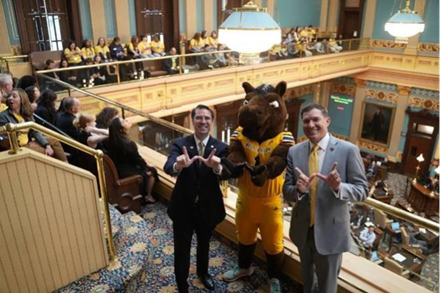
Along with other major state budget wins, as the Chair of the budget for Universities and Community Colleges, my work was instrumental in securing investments to make community college, four-year universities, and skills training more accessible and affordable. The budget I advanced through passage provides increased funding to all Michigan universities and community colleges. It also continues to fund the Michigan Achievement Scholarship and the Community College Guarantee, which help lower the cost of post-secondary education.
Whether at a college, university, or skilled-trade institution, we’re continuing to ensure Michigan residents across the state can access the tools needed to pave their pathway to success. The budgets we passed not only help keep a bright future in reach for our young people; they also safeguard our academic institutions from the federal attacks on DEI programs that are so integral to ensuring education is accessible to anyone willing to put in the work. I’m incredibly proud to have gotten this across the finish line and am looking forward to witnessing how these investments will positively impact our residents and economy far into the future.
Providing A Better Future for Moms and Babies
Rx Kids is the nation’s first community-wide prenatal and infant cash prescription program, and my colleagues and I continue to support this innovative effort to better support moms and babies. I’m incredibly proud that we helped provide the initial budget funding to launch the program in Flint in 2024 and, since then, have continued securing investments to expand it to other parts of the state, including Kalamazoo last year. Most recently, our 2026 budget allocated $270 million to reach nearly 100,000 babies over the next three years — that’s about one-third of all births in Michigan!
Making Everyday Life More Affordable
Along with other measures to lower costs within our bipartisan state budget deal last year, we eliminated state taxes on tips, overtime, and Social Security, so you can keep more of your hard-earned paycheck.
What does this look like in action?
- No taxes on tips will save up to 300,000 Michigan residents an average of $400/year on their state taxes.
- No taxes on overtime will save up to 500,000 workers an average of $500/year on their state taxes.
- No taxes on Social Security will save up to 40,000 eligible seniors $500/year on their state taxes.
Health Care Wins: Lowering Prices, Improving Care
I remain committed to lowering prescription drug prices and health care costs while improving people’s access to and quality of care. This includes supporting bills to:
- Keep prescription drugs affordable and accessible;
- Strengthen support for rural hospitals;
- Establish hospital price transparency;
- Improve mammogram testing and reporting;
- Improve outcomes for moms and babies of color; and
- Require insurance coverage for certain over-the-counter contraceptives.
Tackling the Issues You Care About
Updating Michigan’s Bottle Law
Last year, I reintroduced my proposal to reinvigorate Michigan’s nearly 50-year-old Bottle Deposit lawreintroduced my proposal to reinvigorate Michigan’s nearly 50-year-old Bottle Deposit law to reduce plastic in the waste stream, make it easier for consumers to return their beverage containers, and modernize and revitalize one of Michigan’s most successful policies ever enacted. My proposal would allow plastic water bottles, amongst others, to be eligible for deposit, while allowing consumers to return their containers anywhere, regardless of where they were purchased — something known as universal redemption. It would also provide funding mechanisms to reimburse Michigan’s industry partners, invest in new technology, and continue to support contaminated site cleanups.
Preparing for Future Disasters and Damaging Weather
It’s no secret that tornadoes, ice storms, and dangerous flooding are becoming more prevalent in Michigan. Following the devastating tornado that tore through Southwest Michigan in May of 2024, it became abundantly clear that something needed to be done to ensure our state has adequate funds available to help communities like ours when they’re impactedfollowing weather incidents.
To address the increase in natural disasters in Michigan, I reintroduced legislation last year to increase the cap for the Disaster and Emergency Contingency Fund (DECF), which would make more money available for counties and municipalities impacted by weather-related events. It would also create the State Hazard Mitigation Fund, which would establish a grant program for counties and municipalities to request funding for hazard mitigation programs, allowing them to rebuild damaged infrastructure in a manner that would reduce public exposure to future hazards.
2025 in District 19
$5.8M SECURED FOR COMMUNITY PROJECTS
80+ EVENTS ATTENDED IN DISTRICT
16 BILLS INTRODUCED
7 BILLS APPROVED BY THE SENATE AND SENT TO HOUSE
2 RESOLUTIONS ADOPTED